
Greyhounds: What's Good About 'Em, What's Bad About 'Em
Greyhound temperament, personality, training, behavior, pros and cons, advice, and information, by Michele Welton, Dog Trainer, Behavioral Consultant, Author of 15 Dog Books
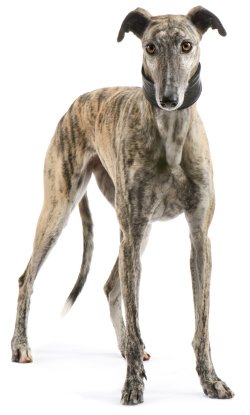
The Greyhound belongs to a family of hunting dogs called sighthounds. The slender, long-legged sighthound hunts by spotting the movement of a prey animal across a vast distance, then running the animal down with lightning speed.
The Greyhound, though, is a unique sighthound developed more for track racing than for hunting. Greyhound racing is a high-stakes, brutal industry that is fortunately being banned in more and more communities.
Greyhound racing dogs who are past their prime, or who simply lose too many races, would face quick deaths if it weren't for rescue groups who take them in and foster them. Greyhound Rescue groups teach these ex-racing dogs (who have lived their entire lives in kennels) how to be good family companions. The vast majority of Greyhounds found in family homes today are ex-racing dogs.
With their quiet dignity and independence, Greyhounds are calm and quiet indoors, moving lightly and gracefully rather than toppling your lamps. They are comfort-loving dogs who want to snuggle on a soft couch or under a warm blanket.
The fastest of all breeds (a Greyhound can outrun a horse in a sprint), once he has exploded into his powerful driving gallop for a short time, he is content to sleep for the rest of the day.
Which brings up an important requirement for owning a Greyhound – you should have a good-sized, fenced area in which he can spring all-out at least once every few days. Greyhounds are not built for endurance, so they don't want or need hours of jogging exercise.
This sensitive breed prefers peace and quiet and soft-spoken people. He does not do well in an environment with chronic tension or loud voices.
Most Greyhounds are politely reserved with strangers, and prefer to lean against their owner's leg rather than approaching people they don't know.
Greyhounds are peaceful with other dogs who are medium to large in size. But because of their heritage, they can be a serious chaser of cats and tiny dogs. However, many individuals can learn to coexist with these smaller pets.
Greyhounds are nonaggressive (they tend to freeze when challenged or attacked) and they can be touch-sensitive (startling when touched unexpectedly). Because they are so docile, they must be trained with a very light hand and much more praise than correction.
This quiet dog seldom barks. (But many individuals take great delight in stealing and hoarding food and toys!)
If you want a dog who...
- Has a tall, slender, elegant build
- Has a sleek easy-care coat that comes in many colors
- Is extremely athletic and graceful – can run swiftly and jump great heights
- Has a calmness and quiet dignity that is often likened to a cat
- Is polite with people and other dogs
- Is readily available through the many Greyhound rescue organizations for ex-racing dogs
A Greyhound may be right for you.
If you don't want to deal with...
- Providing a safe enclosed area where he can occasionally gallop
- Strong instincts to chase other living creatures that run
- Potential for fearfulness or timidity if not socialized enough
- An independent "what's in it for me?" attitude toward training
- Emotional sensitivity to stress and abrupt changes in schedule
- Slowness to housebreak
A Greyhound may not be right for you.
 |
Dog Breed Traits – Which Traits Are Right For You? In this brand new series, I'll help you decide which dog breed traits would best suit you and your family, your home and yard, and your lifestyle, so you can choose the best dog breed for your family. |
Keep in mind that the inheritance of temperament is less predictable than the inheritance of physical traits such as size or shedding. Temperament and behavior are also shaped by raising and training.
FREE eBooks by Michele Welton
 "Respect Training for Puppies" and "Teach Your Dog 100 English Words" are free step by step guides to teaching your pup to be calm and well-behaved.
 "11 Things You Must Do Right To Keep Your Dog Healthy and Happy" is a free guide to keeping your dog mentally, physically, and emotionally happy and healthy so you can enjoy a longer lifetime of companionship.

More traits and characteristics of the Greyhound
If I was considering a Greyhound, I would be most concerned about...
- Providing enough running exercise. Greyhounds don't need miles of running, but they also can't get by with a small yard and leashed walks around the block. They're content to be couch potatoes, yes, but only if they have regular access to a large fenced area where they can gallop for a bit – fenced because these dogs are chasing addicts with sharp eyesight for movement. Outside of a fenced area, if something catches their attention on the horizon, they will take off and not come back.
See if there is a dog club in your area that offers an activity called lure coursing, which is chasing a mechanical lure in a controlled setting. This is an appropriate outlet for the full-speed galloping behaviors that are "hardwired" into your Greyhound's genes.
- Chasing other animals that run. Greyhounds are usually fine with the pets in their own family. But they are lightning-fast, and individuals with a strong prey instinct could seriously injure or kill any small running animal.
Fortunately, most Greyhounds today are placed in their new homes by Greyhound rescue organizations. These groups have already done rigorous screening to evaluate each dog's behavioral tendencies. They are experienced at predicting whether any given Greyhound will be reliable with your cats, for example. Honestly, though, I don't know that I would feel comfortable keeping a Greyhound with one of my cats or toy-breed dogs.
- The independent temperament. Sighthounds are very different from other kinds of dogs. They won't try to haul you around on the leash like many other breeds do; instead they might display passive resistance by bracing their legs and refusing to move at all. Greyhounds are independent thinkers who don't particularly care about pleasing you, so you need to rely on establishing the right leader-follower relationship where your Greyhound understands that you mean what you say. Read my free online training programs.
- Emotional sensitivity. Be honest... is there tension in your home? Are people loud or angry or emotional? Are there arguments? Greyhounds are extremely sensitive to stress and can end up literally sick to their stomachs, with severe digestive upsets and neurotic behaviors, if the people in their home are having family problems. Sighthounds are peaceful dogs who need a peaceful, harmonious home.
Should you consider a Greyhound if you have young children? It depends on the individual dog and the individual children. These sensitive dogs often feel overwhelmed by the loud voices and quick movements that children can't help making – and stress and shyness may be the result. Realistically, the final decision won't be up to you, since Greyhound rescue groups have their own policies about children. Personally I prefer to recommend Greyhounds for adult-only homes.
- Housebreaking. Most people don't acquire Greyhound puppies; they acquire an adult ex-racing dog who has lived his life in a kennel, not in a family home. Whether that dog will have learned good bathroom habits or bad bathroom habits varies. Usually the breed is clean.
- Health problems. Greyhounds are extremely prone to a life-threatening digestive syndrome called bloat, which arises suddenly and can kill a dog in only a few hours. In addition, an alarming number of Greyhounds die early from cancer. Read more about Greyhound Health.
 About the author: Michele Welton has over 40 years of experience as a Dog Trainer, Dog Breed Consultant, and founder of three Dog Training Centers. An expert researcher and author of 15 books about dogs, she loves helping people choose, train, and care for their dogs.
My best-selling books – now available FREE on my website
 Respect Training For Puppies: 30 seconds to a calm, polite, well-behaved puppy is for puppies 2 to 18 months old. Your puppy will learn the 21 skills that all family dogs need to know. Click here to read for free.
 Teach Your Dog 100 English Words is a unique Vocabulary and Respect Training Program that will teach your adult dog to listen to you and do what you say. Click here to read for free.
 11 Things You Must Do Right To Keep Your Dog Healthy and Happy helps your dog live a longer, healthier life. Get my honest advice about all 11 Things before you bring home your new puppy, because some mistakes with early health care cannot be undone. Click here to read for free.
Related posts you might enjoy